

Before my best friend Ellie and I took the chicken bus from Antigua to Lake Atitlán, I had no idea what I was getting myself into. I knew that we were at quite a fair risk of being pickpocketed, but besides that I really didn’t know what to expect. We’d heard what Guatemala buses were really like from everyone at our hostel: painted-up old school buses, packed with people, hurtling around mountain bends. I knew I wanted to give it a go, but I don’t think I’d realised quite how in danger I would feel.
This guide covers everything you need to know: what the chicken bus actually is, the most common routes, how much it costs, safety advice, luggage, and a full honest account of our journey so you know exactly what you’re getting yourself into.
Quick facts about the chicken bus in Guatemala
- Cost per leg: Q10 to Q40 (around €1 to €4.50)
- Cash only: Guatemalan Quetzales, small notes essential
- Best for: budget travellers, backpackers, anyone after an authentic experience
- Not recommended for: solo female travellers, after dark, or from Guatemala City
- Routes:
- Panajachel → Quetzaltenango (Xela): Q20–35 (€2.30–4.10)
- Antigua → Quetzaltenango (Xela): Q35–50 (€4–6)
- Quetzaltenango → Guatemala City: Q35–60 (€4–7)
- Panajachel → Guatemala City: Q30–45 (€3.50–5.30)
What Is the Chicken Bus in Guatemala?
The chicken bus is the name travellers and backpackers use for the public buses in Guatemala and across Central America more broadly. The locals just call it the bus, so maybe hold off on saying “chicken bus” too enthusiastically in front of them.
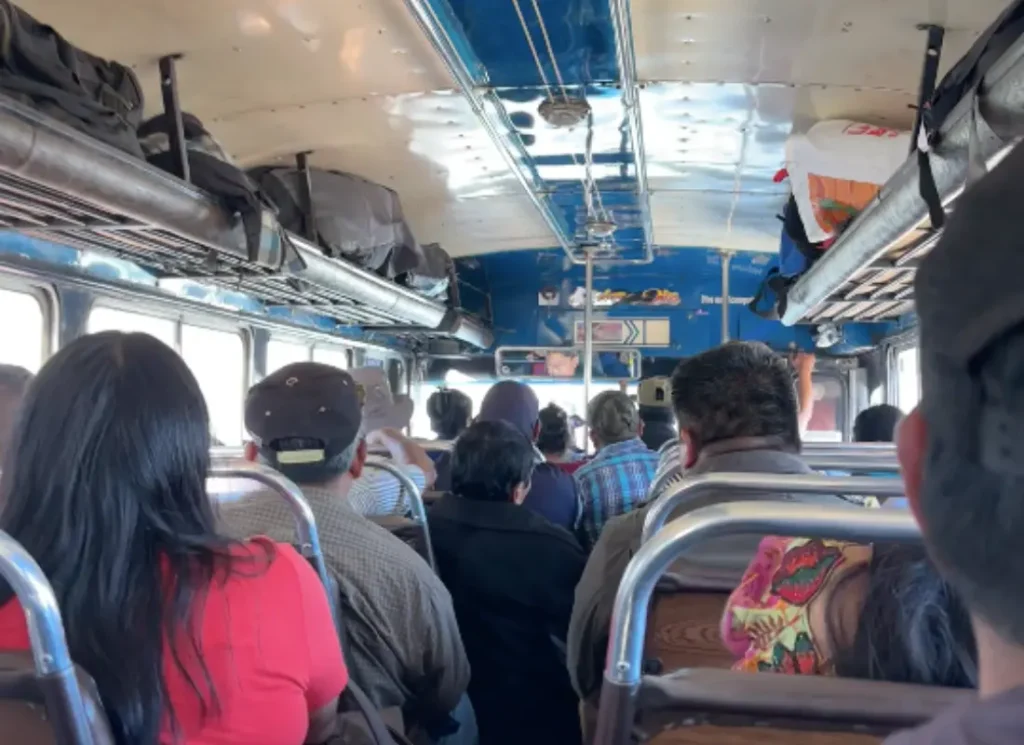
They’re repurposed, repainted old American school buses, which means they look absolutely brilliant on the outside, all bright colours and elaborate paintwork, but the inside is very much no-frills. Hard seats, no air conditioning, and more people crammed in than you’d think physically possible. You might even share your journey with live animals (we genuinely literally saw a chicken on the chicken bus), bags of produce, or someone’s entire market haul. It’s a genuine slice of local life.
These are the main form of public transportation for local people going about their daily lives, which is precisely what makes riding one such an authentic experience. They connect towns and different villages across the country and are the cheapest option available by a considerable margin.
Is the Chicken Bus Worth Doing?
Taking the chicken bus is quite the adventure, and it was one of the most talked-about experiences among every traveller we met in Guatemala. The question isn’t really whether it’s worth doing, it absolutely is, but whether you’re the right kind of traveller for it.
The UK government advises against using these buses at all, which is worth factoring in (think: your travel insurance might not be valid if you have something stolen on the bus, for example). That said, plenty of backpackers take them every day without incident, and as a budget-friendly travel experience it’s hard to beat.
Chicken Bus Guatemala: Safety Tips
Safety is the thing people ask about most, so let me be upfront.
There are two main risks: the road conditions (the driving is wild, especially on mountain roads, and speed limits are more of a suggestion) and pickpocketing. You won’t find seat belts or handles on a chicken bus. On our descent into San Pedro at Lake Atitlan, the turns are so tight that, on occasion, the huge rickety school bus has to do a three-point turn, and the sheer drops on either side are not for the faint-hearted.
I also almost fell victim to a pickpocket. Someone created a commotion on the bus, and before I’d even registered what was happening, a hand was in my jacket pocket. The only thing he got away with was my lipbalm, but if I’d not had my wits about me, it could have been a lot worse.
A few non-negotiables before you get on:
- Don’t take the chicken bus alone, especially if you’re female, visibly a tourist, or don’t speak much Spanish. I’m usually a solo female traveller and would have felt out of my depth doing this journey by myself.
- Set off in the morning; it’s safest early in the day and rules out any chance of being stranded after dark.
- Keep valuables secured to your body in something like a bumbag or money belt.
- Act confident, even when you’re unsure, it goes a long way!
How Much Does the Chicken Bus Cost in Guatemala?
The chicken bus is the cheapest way to travel in Guatemala by a long stretch. Here’s a rough breakdown, with a comparison to the tourist shuttle, so you can see exactly how much money you’re saving:
- Single short leg: Q10 (around £1.10 / $1.20)
- Longer leg, e.g. Chimaltenango to Panajachel: Q25 to Q40
- Antigua to Lake Atitlán in total (recommended route): Q40 to Q60 (around £4.50 to £6.80)
- Tourist shuttle Antigua to Panajachel: Q130 to Q200 (around £14 to £22)
It’s cash only, always, and small denominations are essential. Drivers do not accept dollars or cards, and they won’t thank you for handing over a large note. Get Guatemalan Quetzales sorted before you travel, ideally from a cash machine in Antigua rather than the airport.
The Most Common Chicken Bus Routes in Guatemala
You can’t look up the bus routes online, but the locals and drivers know them inside out. Here are the routes most travellers use:
Antigua to Lake Atitlán (Panajachel) by Chicken Bus
This is the most popular chicken bus journey for backpackers and travellers, and the one I’ve done myself. The recommended route is:
Antigua -> Chimaltenango -> Panajachel
Start at the bus station next to the Mercado Central in Antigua, where drivers will be calling out their destinations as soon as you arrive. Your first bus goes to Chimaltenango (Q10, around £1.10). From Chimaltenango, board a second bus to Panajachel (around Q25 to Q40). From Panajachel, take the public boat to whichever town around the lake you’re headed to: San Pedro La Laguna, San Marcos La Laguna, San Juan La Laguna, Santa Cruz La Laguna, and other small villages are all accessible by a short boat ride.
Total journey time is roughly 3 to 4 hours depending on connections. Total cost, if you take this direct route, should be Q40 to Q60.
Note that some drivers, when you tell them your final destination, will say yes and then drop you somewhere unexpected. The golden rule: always ask “directly?” before you commit.
Chicken Bus from Antigua to Guatemala City
The chicken bus between Antigua and Guatemala City is technically possible but I’d strongly advise against it. Guatemala City carries a higher security risk than the rest of the country, and local buses from or to the city are not recommended for tourists.
If you need to travel between Antigua and Guatemala City, a shared shuttle bus or private transfer is a much safer and still affordable option. It’s not worth the risk on this particular route.
Chicken Bus from Guatemala City to Antigua
As above, this route is not one I’d recommend for tourists on a chicken bus. The journey by road takes around 1 to 1.5 hours, but the safety risk of using local buses from Guatemala City is not worth it. Take the shuttle service instead, which offers hotel pickup and drops you at your destination in Antigua directly.
Chicken Bus from Panajachel to Guatemala City
This route exists but again, I’d steer clear of it for the same reasons as above. If you’re travelling this way as part of a longer Guatemala itinerary, consider a direct shuttle, which will be significantly more comfortable and safer for this particular leg.
A common stop on longer chicken bus journeys in this direction is Los Encuentros, a busy interchange where you can switch buses towards various destinations. It’s a bustling spot and locals will help you find the right bus if you ask.
Chicken Bus Between Lake Atitlán Towns
Generally, I don’t recommend using the chicken bus to get between the various towns at Lake Atitlan. There may be some exceptions, but if you refer to my story about my best friend Ellie and I travelling to San Pedro by chicken bus, you’ll understand what I’m talking about! The best thing you can do is take the chicken bus to Panajachel and then take a boat (lancha) from there. Tuk tuks are also common for short hops within and between the smaller lakeside towns, such as between San Pedro and San Juan.
Chicken Bus vs Tourist Shuttle: Which Is Best?
The tourist shuttle is quicker, more comfortable, and direct. It offers hotel pickup and drops you at your destination, which is ideal if you’re tired, travelling solo, or carrying a lot of luggage. A shared shuttle bus from Antigua to Panajachel typically costs Q130 to Q200 (around 14€ to 22€). A private shuttle or private transfer will cost more but gives you your own schedule and a private car to yourself.
The chicken bus is the cheapest option by far, it’s the adventure option, and it’s the one that makes for a much better story. It’s slower, bumpier, and requires quite a bit of confidence. It’s also one of the most memorable things I did in Guatemala.
My recommendation is to do exactly what we did: take the chicken bus on the way there, for the experience, and then treat yourself to the tourist shuttle back.
Rental car is also theoretically an option in Guatemala, though the road conditions, mountain roads, and driving style make it a challenge and it’s not something I particularly recommend (and it’s not common amongst tourists here)
Step-by-Step: How to Take the Chicken Bus in Guatemala
- Get yourself to the right starting point. It’s not always obvious exactly where the chicken buses leave from, and it’s not marked on Google Maps or anything like that. Generally you have to ask a local, or ask at reception at your accommodation. In Antigua, head to the bus station next to the Mercado Central. It’s busy and a bit chaotic, but drivers will make it very clear where their buses are going.
- Find a bus with the right destination. Okay, that’s obvious, but it’s not as easy as you think; there’s no departure board, there usually isn’t even a buses’s destination on the front. But, you will have a chaos of drivers yelling where they’re going at you, so it won’t be long until you find someone that’s going in your direction. Many drivers are helpful and can help you to make a connection, but the majority only speak Spanish.
- Expect to make a change. There are no direct chicken buses from Antigua to Lake Atitlán, for example, even though it’s one of the most well-trodden routes. There are specific spots where it’s common to change buses, such as Chimaltenango on the way from Antigua to Lake Atitlan, that you’ll hear repeated over and over again, and sometimes appear to be in the middle of nowhere.
- Keep an ear out for your stop, or check it on Google Maps (as long as you’re keeping a sharp eye on your phone). Locals and drivers know the routes inside out, so don’t be afraid to ask a kind looking stranger.
- Learn a few key Spanish phrases. The bus drivers don’t speak English, or if they do, they don’t have the time or inclination to use it. At the very least, know your destination name, and “Cuanto cuesta?” (How much is it?).
What Happens to Your Luggage?
It is common on chicken buses and tourist shuttles alike that your bag will end up on the roof, and it’s generally fine. They strap them down well, but definitely keep anything especially valuable in a smaller bag that you can take on board with you.
Ellie and I were travelling light: she had a 40L rucksack, I had a 30L, and we each had a small tote and a bumbag for valuables. All four of our drivers let us bring all of our bags on board, though some offered the roof if we preferred. Whatever goes anywhere near the outside of any vehicle: make sure everything is properly fastened. A boat driver once tipped Ellie’s bag upside down and her water bottle went straight into Lake Atitlán (luckily he got it back for her, but it could just as easily have been a phone/laptop/etc.
Top Tips for Taking the Chicken Bus in Guatemala
- Set off in the morning and aim to be at your destination well before dark.
- Carry small denomination Quetzales. Drivers won’t take dollars, cards, or large notes.
- Wear a bumbag or money belt. Your phone should be on your body, not in a pocket!
- A little Spanish goes a long way: memorise your destination and a couple of key phrases.
- Ask your hostel for advice the night before. They’ll know the current situation, any recent safety concerns, and where to change.
- If you’re prone to motion sickness, take motion sickness tablets. The bumpy ride on mountain roads is not the smoothest experience.
Chicken Bus Guatemala FAQs
How much does the chicken bus cost in Guatemala?
Individual legs cost from Q10 (around £1.10) upwards. A multi-leg journey such as Antigua to Lake Atitlán should come to Q40 to Q60 (around £4.50 to £6.80) on the recommended route. Always carry small denomination Quetzales as drivers won’t accept large notes, dollars or cards.
Is the chicken bus safe in Guatemala?
It’s not the safest mode of transport, but plenty of travellers take it every day without incident. The main risks are pickpocketing and the mountain road driving. Travel in the daytime, go with at least one other person, keep valuables secured to your body, and set off early. The UK government advises against using these buses, so weigh that up before you decide.
Do chicken buses run on a timetable?
No. There are no timetables and you can’t look up routes online. Buses are frequent though, often just a minute or two apart, and drivers and locals know the routes extremely well. Ask at every stop.
Do chicken buses take dollars or card?
No. Cash only, in Guatemalan Quetzales, and in small denominations. Sort this out before you travel.
Is there a direct chicken bus from Antigua to Lake Atitlán?
There’s no direct bus. You’ll need to change at least once, usually in Chimaltenango. The recommended route is Antigua to Chimaltenango to Panajachel, then take the public boat from Panajachel to your final destination around the lake.
How long does the chicken bus take from Antigua to Lake Atitlán?
The total travel time is roughly 3 to 4 hours on the recommended route, not counting any waiting time between buses. If you end up on a less direct route as we did, allow closer to 4 to 5 hours.
What should I do with my luggage on the chicken bus?
Keep anything valuable in a small bag that stays with you on board. Your main rucksack may be offered a spot on the roof, which is standard practice and generally fine, just make sure everything inside is zipped up securely.
Can I take the chicken bus if I don’t speak Spanish?
You can, but it’ll be harder. At minimum, memorise your destination name, “Donde cogemos el proximo autobus?” and “Cuanto cuesta?”. Travelling with a Spanish speaker makes everything considerably easier.
Is the chicken bus suitable for solo female travellers?
I’d be cautious. As a solo female traveller myself, I would have found this journey very difficult alone, and I wouldn’t recommend it. Travelling with even one other person makes a significant difference. If you do go solo, travel in the morning, keep your Spanish and your wits about you, and make sure your valuables are well secured.
Is the chicken bus good for digital nomads or longer stays in Guatemala?
If you’re based in one place, say Antigua or Panajachel, the chicken bus is a great way to take day trips to nearby towns affordably. For getting between main bases with lots of luggage or equipment, a shuttle or private transfer will be more practical.
