

If you’re trying to figure out how to get from Antigua to Lake Atitlán, you’ve got a few options: the legendary chicken bus, a shared shuttle service, or a private transfer. This guide covers all three, with a focus on the chicken bus route that I did myself with my best friend Ellie. (Spoiler: we took the chicken bus there and the shuttle back, and both were the right call.)
🚌 Quick Links to Book a shuttle service:
The journey takes 3 to 4 hours by road, so it’s not a quick trip. If you have the time, I’d recommend spending at least a few days at the lake. There are loads of villages to explore at Lake Atitlan, most of which are best reached by boat taxi once you arrive.
Quick facts
- Journey time: 3 to 4 hours (chicken bus or shuttle)
- Chicken bus cost: 40 to 80 Quetzales (roughly $5 to $10 USD)
- Shuttle cost: 130 to 200 Quetzales (roughly $15 to $25 USD)
- Private transfer: around $50 USD
- Changes required: at least one (probably two) on the chicken bus
- Chicken bus best for: budget travellers and backpackers who want a proper local experience
- Shuttle/transfer best for: solo female travellers, first-timers without Spanish, anyone with a lot of luggage
🇬🇹 Heading a different way? Here’s how to get from Guatemala Airport to Lake Atitlán
Your options: chicken bus, shuttle, or private transfer?
Before we get into the full chicken bus story, here’s a quick breakdown of your options for getting from Antigua to Lake Atitlán.
Chicken Bus
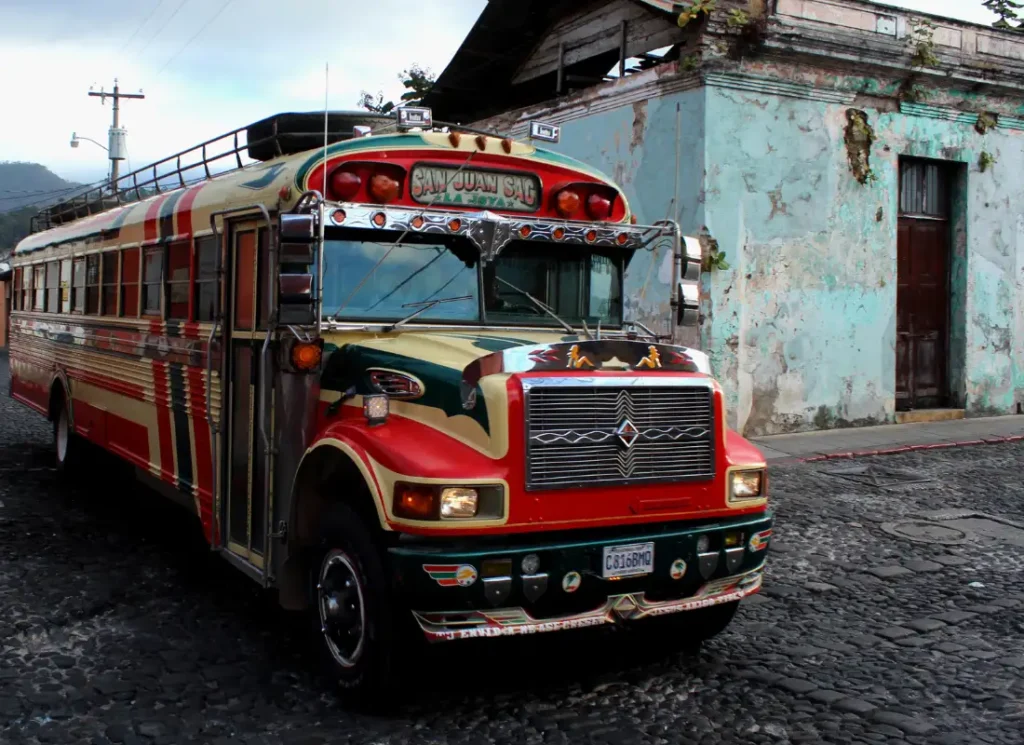
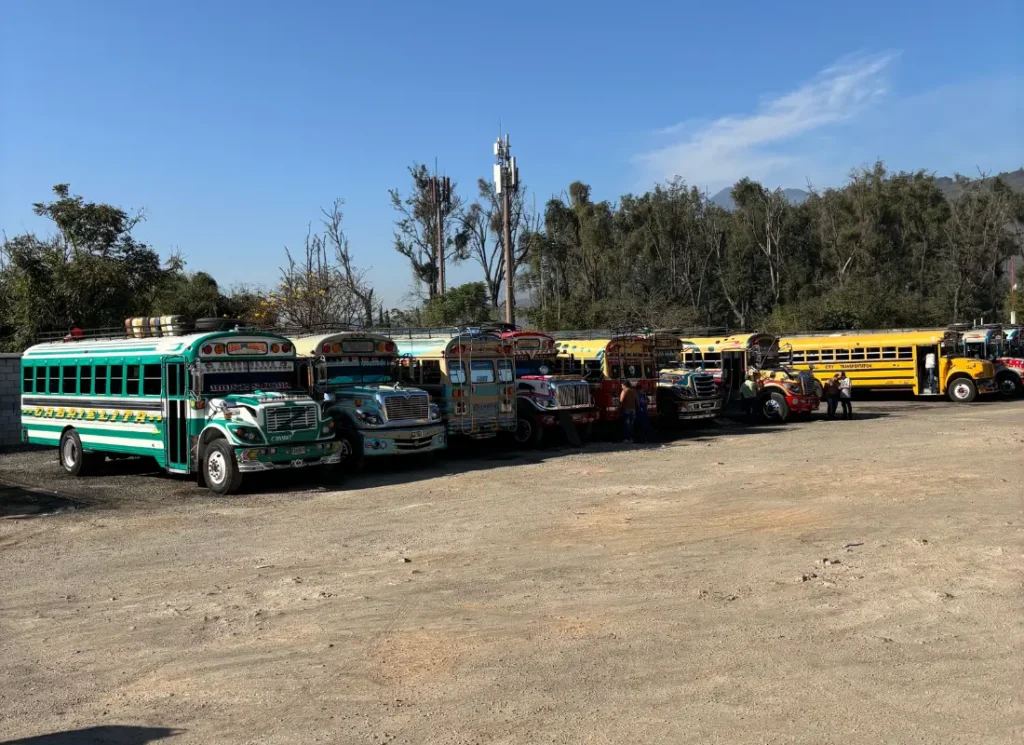
The chicken bus is the cheapest option by far, and it’s an experience in itself. Chicken buses are repurposed, repainted old US school buses that serve as Guatemala’s public transportation system. They look incredible and they run constantly, but they are loud, bumpy, and you will almost certainly be in for a wild ride. They don’t run to a fixed schedule, drivers won’t speak much English, and you’ll be paying in cash only. If you’re on a tight budget or want a proper cultural experience, it’s absolutely worth doing at least once.
Shared Shuttle Bus
The shared shuttle bus is the most popular option for backpackers. It’s faster, more comfortable, and goes directly to your destination. Shuttles offer hotel pickup and will drop you right where you’re going, which makes them a much easier option if you’re tired or carrying a lot of luggage. You can book a shuttle from Antigua to Panajachel online in advance, which I’d recommend for peace of mind.
Private Transfer
A private transfer or private car is the fastest and most comfortable way to travel, and at around $50 it’s not wildly expensive if you’re splitting it. It’s the best bet for a day trip from Antigua to Lake Atitlán, since time is tight and you won’t want to be navigating bus changes on a schedule.
Is the chicken bus the best way to get from Antigua to Lake Atitlán?
That depends on what you’re after. It is not the quickest, it is not the easiest, and the UK government officially advises against using these buses at all. But it is the most memorable, and it is by far the cheapest option.
Having done it myself, I would not recommend the chicken bus to a solo traveller, especially if you are female, don’t speak any Spanish, or are doing it for the first time. It’s quite the adventure, and you really benefit from having at least one other person with you, ideally someone with a bit of Spanish. I’m a solo female traveller by nature, but I was with my best friend Ellie for this trip, and even in a pair there were moments that required some confidence and a bit of improvisation.
The bus drivers do not speak English, or if they do, they won’t have the time or inclination to switch. If your Spanish is limited, go armed with a few key phrases: your destination, “where do I get the next bus?” and “how much is it?” will get you very far.
You can’t look up the chicken bus routes online, but the locals and drivers know them extremely well. If you get totally lost, there’s usually someone close by who can point you towards the right bus stop for your destination.
What happens to your luggage on the chicken bus?
Be prepared for your luggage to be strapped to the roof. This is common on both chicken buses and tourist shuttles, and even on the small boats around Lake Atitlán. It’s generally fine, but I’d recommend keeping anything valuable in a smaller bag that you can take on board with you.
Ellie and I were travelling pretty light (she had a 40L rucksack, I had a 30L, and we each had a small tote and a bumbag). All four of our chicken bus drivers let us bring everything on board, though a couple offered to put the larger bags on the roof if we wanted. When we got onto the boats at Lake Atitlán later, our bigger rucksacks went on top of the small boats, which was non-negotiable.
One tip: strap everything in properly. A boat driver flipped Ellie’s bag upside down and her water bottle ended up in the lake. He did go to considerable lengths to retrieve it, but it could easily have been something more valuable.
Cost summary: Antigua to Lake Atitlán
| Option | Cost (Quetzales) | Cost (USD approx.) | Journey time |
|---|---|---|---|
| Chicken bus | 40 to 80Q | $5 to $10 | 3.5 to 5 hours |
| Shared shuttle | 130 to 200Q | $15 to $25 | 3 to 3.5 hours |
| Private transfer | (usually paid in USD) | around $50 | 2.5 to 3 hours |
How to take the chicken bus from Antigua to Lake Atitlán: the full route
The recommended route is: Antigua → Chimaltenango → Panajachel → boat to your final destination.
We did not take this route. We learned this the hard way. Here’s what happened.
Bus 1: Antigua (Mercado Central) to Chimaltenango
The easiest place to catch the chicken bus from Antigua is at the bus station next to the market (Mercado Central). As soon as you arrive, drivers will be shouting and waving at you. Your first stop is Chimaltenango, because there are no direct chicken buses all the way to Lake Atitlán.
At the time of writing, this leg should cost around 10 Guatemalan Quetzales (roughly $1.25 USD).
Take Quetzales in small denominations. The buses do not accept dollars or card. Tell your driver your final destination and, if they’re a good one, they’ll help you find your next connection at Chimaltenango. Ours was great. He told us to keep a close eye on our belongings and personally helped us change buses at the interchange.
Bus 2: Chimaltenango onwards
When we got off in Chimaltenango, I was expecting some kind of a bus station like we’d departed from in Antigua. I was wrong. We were dropped on the side of a main road, and within seconds another brightly decorated chicken bus pulled up asking where we were going. We said San Pedro La Laguna. He said yes, hop on, 40 Quetzales. This was not strictly true, but we’ll get to that.
This was the bus where I nearly got pickpocketed. Someone near us caused a distraction, and before I’d even registered what was happening, a hand was in my jacket pocket. I know it sounds so cliche, but it happened so fast I wondered if I’d just imagined it. But no, I looked down and my pocket had been opened.
That pocket was where I usually kept my phone, but I’d had the foresight (and the experience of enough previous adventures) to have it secured in a bumbag. The guy got off at the next stop with only my lip balm. (Not a great return on investment, given that I had a MacBook, two phones and over $100 on my person.)
Bumbag: genuinely not optional on the chicken bus.
Buses 3 and 4 (optional, or in our case, a bit accidental)
Here is where things got interesting. There are a few routes you can take depending on where you’re staying at the lake, but my strong recommendation is to go straight to Panajachel and take the public boat from there. You can reach practically any destination by boat taxi from Panajachel:
– San Pedro La Laguna
– Santa Cruz La Laguna
– San Juan La Laguna
– San Marcos La Laguna
– and many more!
Ellie literally told me “let’s get off at Panajachel and take the boat” and I told her no, let’s not go trying another brand new thing today, let’s stick to the bus. Yeah, bad idea.
Our driver dropped us in the middle of nowhere at what I later identified on a map as Kilómetro 148 Carretera Interamericana. He told us to cross the bridge and wait for another bus. Ellie asked if we’d need to change again after that. He said no. He was lying.
A lot of people also switch at Los Encuentros, a busy interchange on the way to Panajachel. If you’re going the long way round, you may end up here.
We crossed the road, asked a few locals (a genuinely useful reminder: almost anyone standing on a roadside in Guatemala will know exactly where you’re going and can point you in the right direction), and spotted someone from our previous bus. He was heading the same way, so we reassuredly waited with him.
A bus turned up and said they could take us to Santa Clara, where we could find a connection to San Pedro. Ellie and I exchanged a look and revived our motto: it’s just another adventure.
Twenty minutes and 10 Quetzales later, we arrived in Santa Clara. The driver told us to wait on the other side of the road. We waited. Tuk-tuks kept pulling over to ask if we were alright. Eventually I flagged one down and asked where the bus to San Pedro stopped. He pointed across the road, about 50 metres up from where we’d been standing.
We crossed. And there, waiting on the other side, was the same man we’d been following since two buses back.
Not a minute later, a full-sized chicken bus rolled up heading to San Pedro. (The wait times for chicken buses are honestly impressive. Even if you have to change four times, you will never wait longer than a few minutes.)
That leg cost another 10 Quetzales, bringing our total to 70Q. People generally pay 40 to 60Q for this journey, so we were definitely overcharged somewhere along the way. For reference, shuttles run between 130 and 200 Quetzales depending on who you book with.
The final stretch down into the valley of Lake Atitlán is, to put it mildly, not for the faint-hearted. The road is so narrow and the bends so tight that the rickety school bus has to do three-point turns on what feel like cliff edges. The driver leans on his horn around every corner because it’s the only way to warn oncoming traffic. The drop is sheer and the views are simultaneously terrifying and breathtaking.
We arrived exhausted in San Pedro and found our hostel without much difficulty. Walking through town, Ellie and I reached two conclusions at exactly the same time: the chicken bus was brilliant and we had absolutely no regrets about doing it. And we were booking a shuttle back to Antigua.
The route we’d recommend (learn from our mistakes)
Antigua (Mercado Central) → Chimaltenango → Panajachel → boat taxi to your destination
Going via Panajachel is safer, more straightforward, and actually quicker than going overland all the way to the western towns of the lake. From Panajachel, the public boat connects to all the main towns on the lake. The boat ride itself is worth it. Lake Atitlán is one of those places that looks even better from the water.
Tips for taking the chicken bus from Antigua to Lake Atitlán
- Set off early in the morning: the buses run all day, but you don’t want to be navigating unfamiliar interchanges after dark
- Bring Quetzales in small denominations. Exact change is always appreciated and the buses don’t take dollars or card
- Keep your valuables in a bumbag, not a pocket or a zip on your bag; pickpocketing is very common
- Most drivers are abrupt and kinda scary, but also helpful, so ask them if you are not sure where you need to go
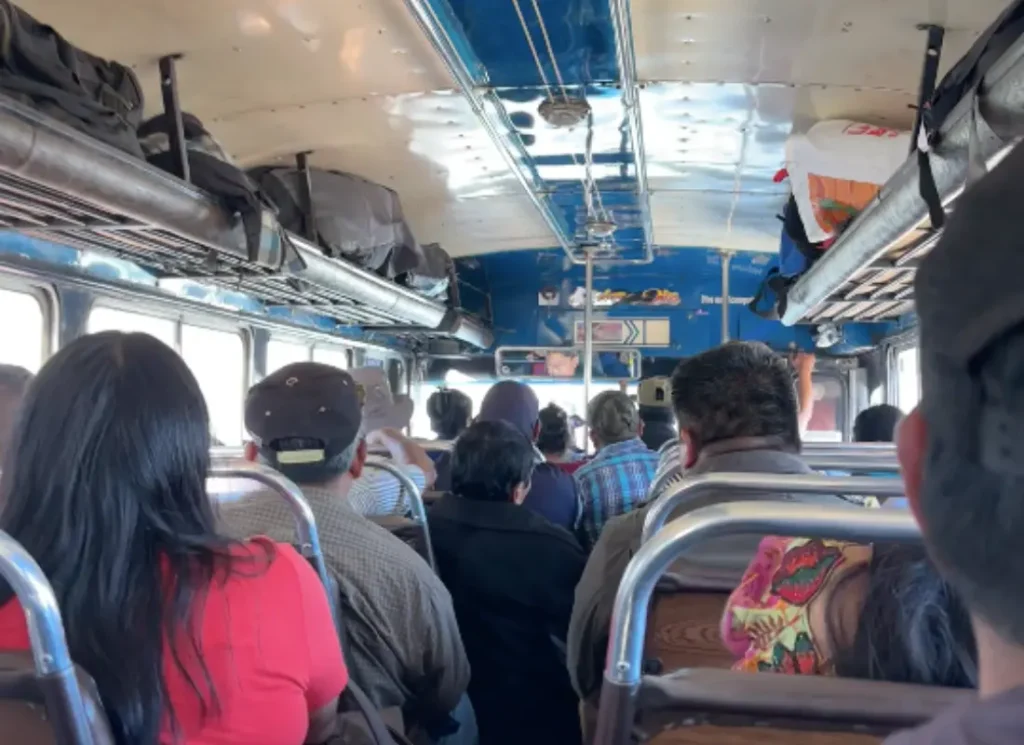
- If you’re prone to motion sickness, take something before you go, the mountain roads are winding, the buses don’t have great suspension, and the descent into the valley is especially bumpy
- Don’t expect seat belts, air conditioning, or fixed schedules
Chicken Bus FAQs
How much does the chicken bus from Antigua to Lake Atitlán cost?
Depending on which route you take and how many connections you make, you’re looking at between 40 and 80 Quetzales in total. At the time of writing that’s roughly $5 to $10 USD. It’s by far the cheapest way to travel between the two. Shuttles will run you 130 to 200Q, and a private transfer is around $20.
Is there a direct chicken bus from Antigua to Lake Atitlán?
No, there isn’t. You’ll need to change at least once, almost certainly in Chimaltenango. If you’re aiming for Panajachel (which I’d recommend as your gateway to the lake), that’s your main stop. From there, take the public boat to wherever you’re staying.
Do the chicken buses take dollars or card?
No. Cash only, and ideally in Guatemalan Quetzales. Small denominations are helpful. For more on money in Guatemala, including the best ATMs and where to exchange currency, check out my guide to money in Guatemala.
Is the chicken bus from Antigua to Lake Atitlán safe?
It depends on who you’re asking and what your threshold is. We did it as a pair of women and felt fine, though I wouldn’t recommend it to a solo female traveller. The physical safety of the bus itself is a different question: no seat belts, no handles in many cases, and the descent into the valley is genuinely white-knuckle. Keep your belongings close, set off in daylight, travel with at least one other person, and you’ll almost certainly be fine.
How long does it take?
The chicken bus takes around 3.5 to 5 hours depending on how many connections you make and how long you wait at interchanges. A shared shuttle is faster, usually 3 to 3.5 hours. A private transfer or private car is the quickest option at around 2.5 to 3 hours.
What should I do about my luggage on the chicken bus?
Your large bag may be strapped to the roof. It’s common and generally fine, but keep anything valuable in a bag you can hold on your lap. A bumbag for your phone, wallet, and passport is non-negotiable on these buses.
Do the chicken bus drivers speak English?
Unlikely. And if they do, they won’t necessarily have time to use it. A few words of Spanish will go a long way: your destination, “how much is it?” and “where do I get the next bus?” are the three you need.
Will we be the only non-Guatemalans on the bus?
Probably, yes. That’s part of the experience.
Can I do a day trip from Antigua to Lake Atitlán by chicken bus?
Technically yes, but I wouldn’t recommend it. The journey takes 3.5 to 5 hours each way on the chicken bus, which doesn’t leave you much time at the lake. If you’re doing a day trip, a private transfer or shared shuttle will save you several hours and a lot of stress.
What’s the best way to get around Lake Atitlán once I arrive?
Boat taxis. From Panajachel, public boats run to all the main towns around the lake, including San Pedro La Laguna, San Juan La Laguna, San Marcos La Laguna, Santa Cruz La Laguna and Santa Catarina. They run frequently and cost just a few Quetzales. It’s a much nicer way to arrive at your destination than a bumpy road would be, and the views of the Sierra Madre highlands over the water are stunning.
Are there tuk tuks at Lake Atitlán?
Yes, and they’re a great way to get around within individual villages. In Santa Clara, a tuk tuk driver was the one who finally pointed us in the right direction when we were standing on the wrong side of the road waiting for a bus that was never coming. Very useful, very cheap, very fun.
What if I get motion sickness?
Take medication before you go. The mountain roads between Antigua and Lake Atitlán are winding regardless of how you travel, but the chicken bus makes it significantly worse. The descent into the valley of Lake Atitlán is the most intense stretch. The private shuttle is a smoother ride on the same roads, so if motion sickness is a serious concern, that might be worth the extra cost.
