

The Acatenango Volcano overnight hike is one of the most popular things to do in Antigua, Guatemala, and for good reason. It’s breathtaking, it’s brutal, and it’s the kind of experience you’ll be talking about for years. But it will also humble you in ways you didn’t expect, especially if you turn up underprepared.
I did the hike about a week after arriving in Guatemala, and while it was still fresh in my memory (and my legs), I wrote down everything I was glad I’d packed, and everything I wish I had. This is that list.
One thing to know before we get into it: the first two hours of the hike are the hardest by far. Someone told me this before I set off, and I held onto those words like a lifeline when I was already out of breath twenty minutes in. If I hadn’t known that, I honestly would have considered turning around.
Who this is for: Anyone doing the Acatenango overnight hike, whether you’re a first-time hiker or a seasoned trekker passing through Central America. This isn’t a gear-head list. It’s a practical one.
Quick Facts: Acatenango Overnight Hike
- Difficulty: Challenging
- Elevation gain: From around 1,500m in Antigua to 3,976m at Acatenango’s summit
- Duration: Typically 2 days, 1 night (some do a day hike, but overnight is far more rewarding)
- Best time to go: Dry season (November to April). Waterproofs are essential in rainy season
- Tour price: Roughly 300Q for the hike, plus 100Q national park entrance fee (often not included)
- What your tour company provides: Water, food, warm coat, gloves and hat (variable quality)
- Optional add-ons: Fuego hike (+200Q), summit hike (usually included)
The Acatenango Packing List at a Glance
Here’s everything you need before we get into the detail:
What to wear
- Hiking boots (not trainers, not trail runners)
- Base layer, mid layer, and outer layer / warm coat
- Rain jacket or waterproof
- Cap or sun hat AND a woolly hat (you need both)
- Extra socks (at least one spare pair)
Essential gear
- Walking sticks (non-negotiable)
- Head torch
- Small day bag for the summit hike (your larger backpack stays at base camp)
- Portable charger
- Sleeping bag (check whether your tour provides one)
Health and survival
- Altitude sickness pills
- Painkillers (paracetamol is fine)
- Rehydration sachets
- Hand sanitizer
- Sunscreen
- Buff or bandana
Food and water
- Extra snacks (protein bars, nuts, biscuits, energy gels)
- Your tour provides 3 litres of water, but consider a reusable bottle
Other essentials
- Toilet paper and a plastic disposal bag
- Cash in Guatemalan Quetzales (at least 500Q)
Your tour operator will provide water, meals, and basic warm clothing, but don’t rely on the clothing being good quality…
The Acatenango Packing List (in more detail)
What to Wear on the Acatenango Hike
Hiking Boots
I can’t stress this enough: Don’t try to do this hike in normal trainers. Trail runners might just about be enough, but really you need proper hiking shoes that have been well worn in.
I wore hiking shoes rather than boots (I hate hiking in boots), and I did almost roll my ankles a couple of times. The terrain is uneven, the volcanic ash on the summit trail is deep and unpredictable, and a twisted ankle halfway up a volcano in the Guatemalan highlands is not a vibe. If you’re not sure what to go with, I recommend taking hiking boots with ankle support.
Warm Layers (More Than You Think)
This is where most people get it wrong, and I was one of them.
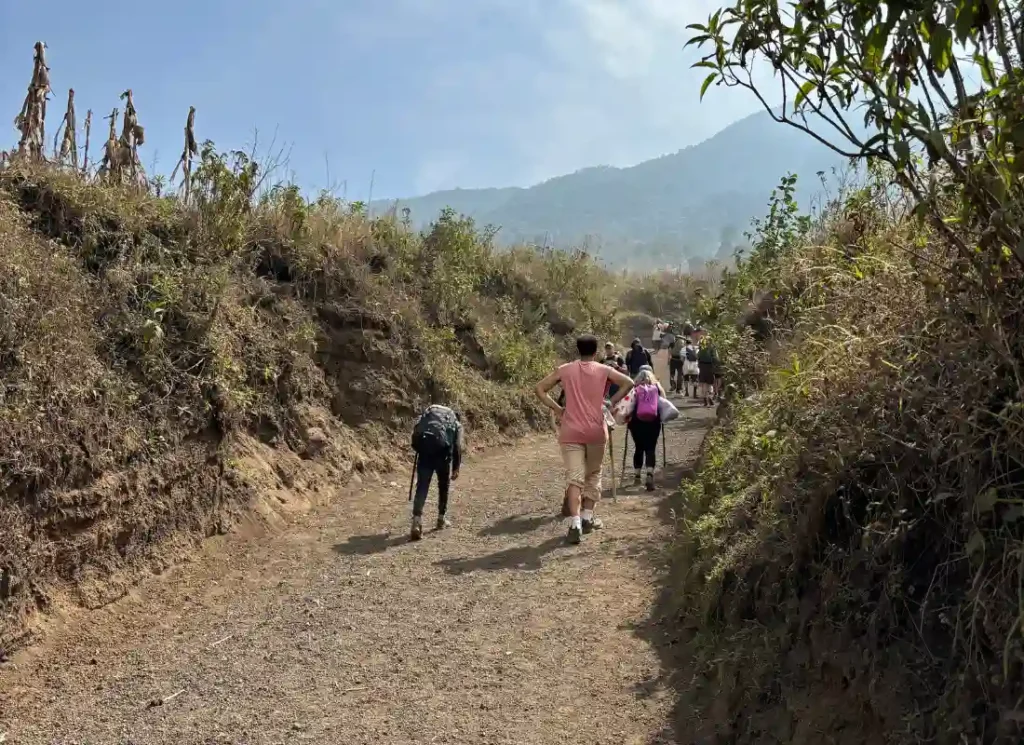
At the start of the hike you’ll be in direct sunlight and sweating through your clothes. About 30% of our group wore shorts and spent the first couple of hours looking smug. By the time we reached base camp, they were digging through their bags for every layer they owned.
Here’s how the temperature works: warm and sunny at the start, cold and windy as you gain elevation, and genuinely bitterly cold at base camp once the sun goes down. We guessed it was around 5 degrees Celsius overnight. At the summit the following morning, I was wearing a base layer, a t-shirt, a jumper, a thick coat, a hat, a scarf, gloves, and two pairs of trousers, and I was still shivering uncontrollably. By the time I got back to base camp I’d stripped most of it off again.
Your tour company will usually provide a warm coat, hat, and gloves, but they’re not great quality, so if you have your own, use them. If you’re backpacking through Central America with only summer clothes like I was, their gear is better than nothing.
Rain Jacket or Waterproof
Even in dry season it can rain on the mountain. In rainy season (May to October) a waterproof outer layer is not optional. A packable rain jacket is ideal because you can stuff it into your day bag when you don’t need it.
A Cap and Sunscreen
The first two hours of the Acatenango hike are in direct, sweltering sunlight, and the sun is stronger at altitude than you’d expect. Sunscreen is a must regardless of your skin type. A cap keeps the sun off your face and scalp, and it weighs almost nothing.
I made the classic mistake of only bringing a woolly hat, which was useless for the first half of the hike and essential for the second. Bring both.
If you do the summit hike the following morning, you’ll be descending in early morning sun. Put sunscreen on before you set off, even though it’s pitch black and feels completely unnecessary. It isn’t.
A Buff or Bandana
The volcanic ash on the summit trail is relentless. If you’ve ever put out cat litter, you know the cloud of fine dust that comes with it? Volcanic ash is kind of like that, except you’re breathing it in for two hours at a steep incline.
At one point I resorted to wearing a Covid mask to try and stop myself from inhaling so much dust kicked up by myself and those around me, and my snot was still black for days afterwards. Someone in my tour group lent me a buff on the way down, and it made an enormous difference!
Extra Socks
I’d suggest at least one spare pair. Between the sweating on the way up and the cold at camp, dry socks at the end of day one feel like a true luxury.
Essential Gear for the Acatenango Overnight Hike
Walking Sticks (Non-Negotiable)
Before I did the hike, walking sticks felt like the kind of thing overprepared people bring. After the hike, I bought my own pair and carried them all the way through South America.
Someone in my hostel told me to “get the sticks” (hiking poles) with such conviction that I didn’t question it. On the climb up to base camp they take the weight off your legs and help you maintain a steady pace. On the summit trail, where you’re wading through thick volcanic ash at a steep incline in the dark, they’re the difference between keeping your balance and using your hands to crawl. On the way back down, steep and slippery, they’re invaluable. (Even though I had sticks, the grip on my shoes was pretty worn down, so I still fell down on my ass like three times).
Your tour company may offer proper trekking poles to rent for around 50Q, or offer you basic wooden poles for 5Q each. They’re literally sticks, but they completely saved this hike for me!
Head Torch
This is essential if you’re doing either the Fuego hike or the summit hike, and most people do at least one. The summit hike starts at around 3:45am, before first light. We left base camp around 4:10am and arrived at the summit just before sunrise at 6am. The entire ascent was done in the dark.
There are usually a lot of people hiking at the same time, so it’s not completely lightless, but there were moments where I had to stop and wait for someone to shine a light for me so I could see where to step. Having my own torch would have made things a lot easier, and a lot less terrifying.
If you’re only going to base camp and not doing any of the additional hikes, you can probably skip this one. But it takes up almost no space in your bag, so why risk it?
Sleeping Bag
Most tour operators provide sleeping bags at base camp, but it’s worth checking with yours in advance. If you’re in a cabin with a full group you’ll generate enough body heat to get by, but if your group is small or you’re in a tent, be prepared to get quite cold during the night.
Portable Charger
There’s no charging at base camp (and your phone will probably be working overtime as a camera!) A small portable charger takes up almost no room and is well worth having.
Health and Survival Essentials
Altitude Sickness Pills and Painkillers
Acatenango’s summit sits at nearly 4,000 metres, whilst Antigua (where you depart from in the morning) is at around 1,500 metres. That’s a serious elevation gain, and faster than doctors typically recommend for safe acclimatisation.
Spend at least 48 hours in Antigua before the hike so your body can start adjusting. I still got a headache and some other altitude sickness symptoms during our night at base camp, despite taking the pills.
One thing nobody told me (or, well, something I didn’t Google): altitude sickness pills are diuretic. I woke up to pee four times the night before the hike and twice during our night at base camp. That’s not ideal when you’re trying to conserve energy, and i might have foregone them in favour of a full nights sleep. Worth knowing before you take them.
Also pack medication for sickness and diarrhoea just in case. A few people in our group were glad they had it.
Rehydration Sachets and Energy Gels
It was my travel companion Ellie’s idea to bring rehydration sachets, mostly for the inevitable street food incident. They turned out to be essential on the hike. She made me one when I got back to base camp after the summit hike, and it genuinely felt like it saved my life. When you’re sweating, exercising hard at high altitude, and not eating or drinking as much as usual, your electrolytes take a hit fast. Electrolyte sachets or tablets weigh practically nothing and fix that problem immediately.
Energy gels are worth bringing too if you’re used to them. We mostly relied on snacks, but gels are a more easily digested hit of energy when your legs are running on empty.
Hand Sanitizer
Running water at base camp is not guaranteed, and you’ll want it before eating and after any bush-based bathroom situations…
Sunscreen
Covered in the clothing section, but worth listing separately so it doesn’t get forgotten. The sun at altitude is deceptively strong, and you’ll be exposed at both ends of the hike.
Food, Water, and Cash
Extra Snacks
Your tour includes meals, and they’re usually decent. We got cooked vegetables, rice, and bread. But altitude sickness can suppress your appetite, which is exactly when you need to keep fuelling up. Eat little and often rather than waiting for meals.
I snacked on my lunch pack the whole way up rather than eating it in one go. Protein bars, nuts, breakfast biscuits, and crisps all made the cut. There are a couple of small snack stops on the lower part of the trail, but don’t count on them.
Water
Your tour operator provides 3 litres of water per person. Two are for drinking; one goes towards cooking dinner, hot chocolate, and breakfast at base camp. That’s pretty standard, but check with your tour company before you go. Consider bringing a reusable bottle so you can manage your water throughout the day rather than carrying open bottles.
Guatemalan Quetzales in Cash
This is where a few people in our group got caught out. The tour price (roughly 300Q) often does not include the national park entrance fee, which is another 100Q payable on arrival. The optional Fuego hike costs around 200Q extra, and we were told it would be 100Q right up until we were standing at the entrance. Bring more cash than you think you need.
Walking stick rental adds another 5 to 50Q depending on the type. Everything on the mountain is cash only, in Quetzales. No cards, no dollars, and small denominations are useful.
A safe amount to bring: at least 500Q, plus whatever you’ve already paid for the tour.
What the Tour Includes (and What It Doesn’t)
This is worth knowing before you go, because a few people in our group were caught off guard.
Your tour price (roughly 300Q) typically covers the hike itself, meals, accommodation at base camp, and basic gear like a warm coat and hat. What it often does not include:
National park entrance fee: 100Q, payable on arrival. Check in advance whether your tour includes this or not, because many don’t.
The Fuego hike: This optional hike to get closer to Volcan de Fuego costs around 200Q extra. We were told it would be 100Q and didn’t find out the real price until we were standing at the entrance. Bring more cash than you think you’ll need.
Walking stick rental: Around 50Q for proper poles, 5Q for the wooden variety.
Always pay in Guatemalan Quetzales. Bring cash in small denominations. Cards and dollars are not accepted on the mountain.
The Optional Hikes: Fuego and the Summit
The Fuego Hike
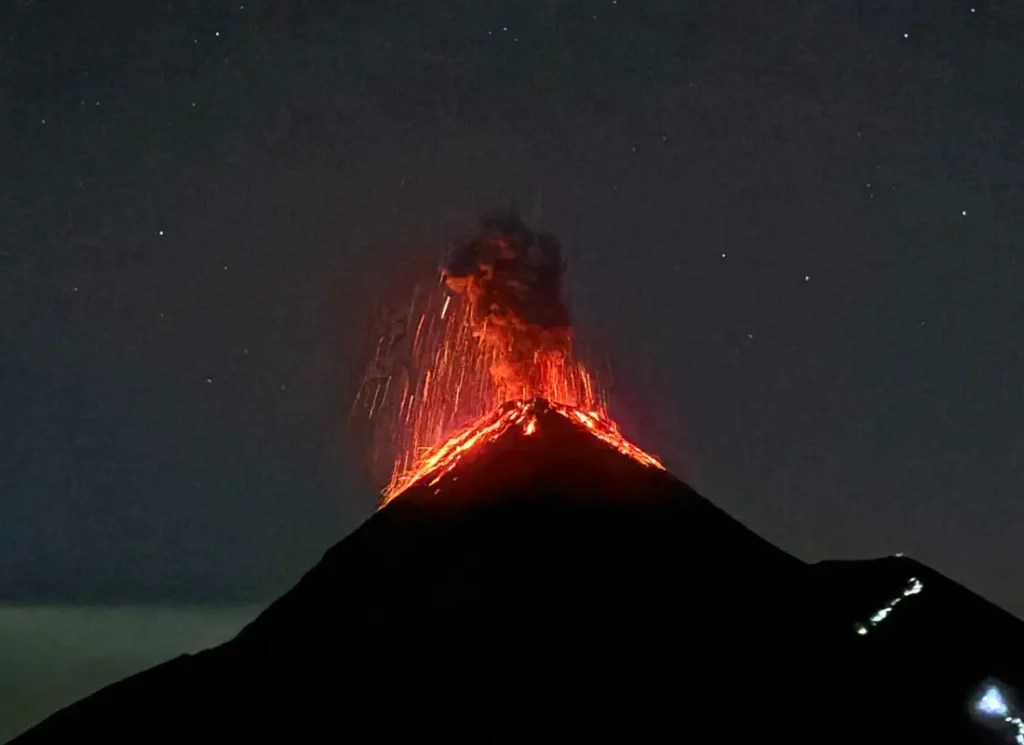
You can see Volcan de Fuego erupting from base camp, and it is spectacular. The Fuego hike gets you significantly closer. It’s done at sunset or after dark depending on your arrival time at base camp, and you walk back in pitch black, which is why a head torch earns its place on this list.
I didn’t do the Fuego hike. By the time I got to base camp, I knew I needed to save every scrap of energy for the summit the following morning. A lot of people in our group had planned to do both, but most of them didn’t make it to the summit after the Fuego hike. Worth keeping in mind if you’re not a seasoned hiker or aren’t used to high altitude.
The Summit Hike
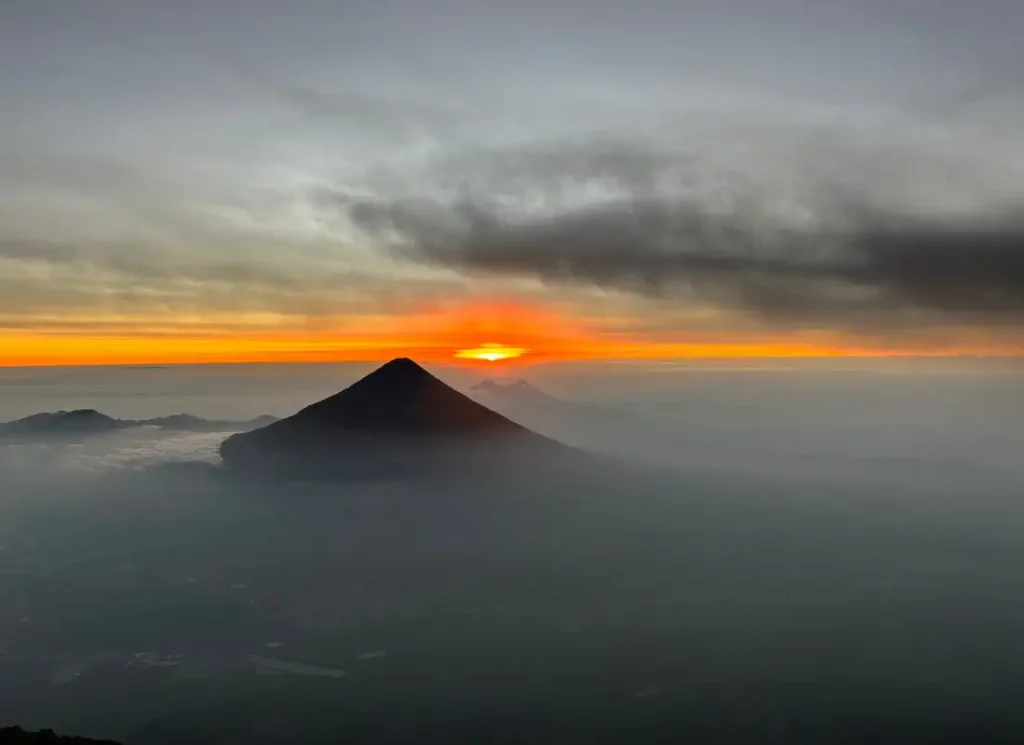
This is the one. You leave base camp at around 4am, hike for about two hours in the dark through deep volcanic ash, and arrive at the summit of Acatenango just before sunrise. The ash is the most difficult part: it’s like walking through thick snow on a very steep incline. That’s why the walking sticks matter so much.
The summit itself is cold beyond anything I expected. I was wearing everything I owned and still shivering uncontrollably for the half hour we spent up there. By the time I got back to base camp, I’d stripped most of it off again.
Common Mistakes to Avoid on the Acatenango Hike
Not taking walking sticks. It sounds optional until you’re trying to wade through volcanic ash at 4am. I promise it’s worth it!
Underestimating the cold. The temperature swing between the bottom and the summit can extreme. Of course it depends on the time of year that you go, but during the night at that altitude it’s always going to be at least a bit cold.
Skipping the snacks. Altitude suppresses your appetite, but you still need fuel. The best thing you can do is bring lots of snacks and eat little and often, even if you don’t feel hungry.
Not bringing cash. The entrance fee and any extras are cash only, in Quetzales.
Not using sunscreen! The first two hours are in full sun, and the descent the following day is in early morning sun at altitude; both of these are a recipe for getting burnt.
What NOT to Bring
Heavy luggage. You already have to carry your own food and water, which doesn’t sound like a lot, but you really feel it when you’re walking up a steep incline at altitude. You can hire a porter to carry your bag for you, which a few people in our group did, and I think that makes all the difference to how worn out you get. In hindsight, I probably should have done that too – then maybe I would have made it to Fuego!
Acatenango Packing List FAQs
Do I need hiking boots for Acatenango?
Yes, hiking shoes are the bare minimum, but full boots are better. The terrain is unpredictable, the volcanic ash is deep and unstable, and the descent is steep and slippery. I wore hiking shoes and nearly rolled my ankle multiple times. Don’t attempt this in trainers or trail runners.
Does the tour company provide equipment?
Most tour operators provide water (usually 3 litres), meals, and basic warm clothing including a coat, hat, and gloves. The quality varies but is generally fine as a backup. Trekking poles may be available to rent for a small additional cost. Check with your specific tour company in advance.
How much cash should I bring for Acatenango?
Bring at least 500Q to be safe. The tour itself is around 300Q, the national park entrance fee is 100Q (often not included in the tour price), the Fuego hike is around 200Q extra if you want to do it, and pole rental adds another 5 to 50Q depending on the type. Everything is cash only in Guatemalan Quetzales.
Is altitude sickness a concern on the Acatenango hike?
Yes. The summit is at nearly 4,000 metres, which is a significant elevation gain from Antigua. It’s worth spending at least 48 hours in Antigua before the hike to acclimatise, and altitude sickness pills can help. I still got a mild headache despite taking them, but paracetamol sorted it out. Be aware that many altitude sickness pills are diuretic, so factor that in.
Can you do Acatenango as a day hike?
Technically yes, but the overnight experience is what makes it. Watching the sunrise from the summit and seeing Fuego erupting at night from base camp are the highlights that a day hike can’t give you. Most people doing the hike in Guatemala will tell you the same thing: stay overnight.
Is the Fuego hike worth doing?
That depends on your energy levels and fitness. Seeing Volcan de Fuego erupt up close is genuinely spectacular, but the hike is harder than people expect. A lot of hikers in my group did the Fuego hike and then didn’t have enough left in the tank for the summit the next morning. If you’re a confident hiker and you’re used to high altitude, go for both. If you’re not sure, choose one.
Related reading
Here’s how to get from Guatemala Airport to Antigua, and if you’re planning your route through Central America, the Guatemala backpacker trail guide is a good place to start. It covers everything you need to know, from Lake Atitlan to Tikal and Flores! Here’s everything you should pack for Guatemala, and how to budget for your trip in Latin America.

Hello! I just read your blog about the volcano hike. I am wondering if you still remember the name of the travel agency (and maybe the location) you paid 300Q? Thank you!
Hey Leo! I wouldn’t necessarily recommend the agency I used. We found that, in the end, the majority of people ended up paying the same amount, as we had to pay 300Q plus entrance fees and additional money to do the Fuego hike, etc, whereas other people paid maybe 500Q but that included everything. I’d recommend asking your accommodation and checking what is included in the price, as almost everyone we met (including us) booked it via their accommodation 🙂